 EN

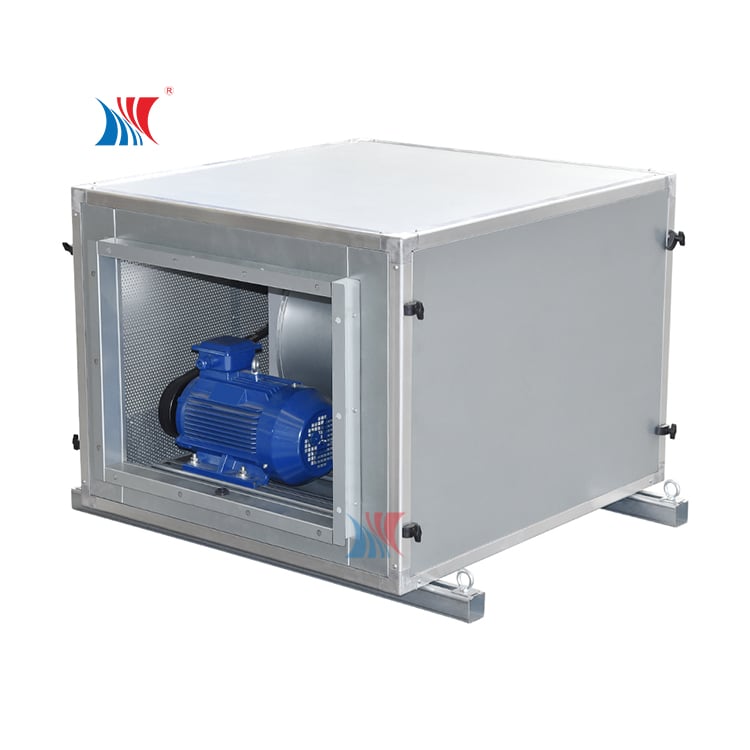
Core Design Principles for High-Temperature Centrifugal Fans
Thermal Expansion Management in Radial vs. Backward-Curved Impellers
Radial impellers—with their simple, flat-blade geometry—are inherently more tolerant of thermal expansion. Stress distribution remains even across the blade, and larger tip clearances can be accommodated without severe efficiency loss. In contrast, backward-curved impellers rely on precise aerodynamic curvature; even minor distortion from elevated temperatures can cause performance degradation, imbalance, or rotor-stator contact. As outlined by the Air Movement and Control Association (AMCA 2023), housing design must proactively manage thermal growth by adjusting axial and radial clearances—especially between the impeller and inlet cone. At extreme temperatures, a backward-curved fan may require up to 0.020-inch additional tip clearance to prevent rubbing, directly compromising aerodynamic efficiency. For this reason, radial impellers are typically specified above 1000°F where mechanical robustness outweighs peak efficiency needs, while backward-curved designs remain preferred below 800°F for optimal energy performance. Shaft axial expansion is another critical factor: bearing arrangements like AMCA Arrangement 8—featuring an outboard bearing—allow controlled axial growth, whereas flexible couplings or thermal barriers become essential for backward-curved fans to maintain alignment.
High-Temp Material Selection: Cast Iron, Inconel, and Ceramic-Coated Components
Material selection must align with both temperature severity and exposure duration. Cast iron offers cost-effective thermal stability up to 800°F and remains widely used for housings and moderate-temperature impellers. Beyond that threshold, nickel-based superalloys such as Inconel 625 become necessary: it retains over 150 ksi yield strength at 1400°F—far exceeding cast iron’s rapid degradation above 1000°F. Ceramic coatings (e.g., alumina or zirconia) serve as effective thermal barriers on impeller blades, shafts, and housings, reducing surface temperatures by up to 200°F and extending service life under intermittent thermal spikes (Ceramic Industry 2022). A fan handling 1500°F exhaust might combine an Inconel impeller with a ceramic-coated shaft to balance durability and cost. Crucially, material pairings must account for differential thermal expansion—e.g., pairing a cast iron housing with an Inconel impeller is common in steel mill furnace exhaust systems, where the housing operates cooler and benefits from lower-cost material, while the impeller bears the full thermal load.
Housing Integrity, Sealing, and Insulation Under Sustained >500°F Load
Sustained operation above 500°F demands housing designs that resist distortion, leakage, and unsafe surface temperatures. Thick-gauge structural steel, reinforced flanges, and engineered expansion joints preserve dimensional stability. Per AMCA guidelines, external housing surfaces should remain below 140°F for personnel safety and to minimize facility cooling loads—achievable through proper insulation. Mineral wool or calcium silicate insulation, applied at recommended thicknesses (e.g., 2 inches), can reduce surface temperatures by over 100°F. High-temperature gaskets—graphite or mica-based—are essential at all joints to seal against hot gas leakage. In continuous 700°F service, inadequate insulation risks thermal bowing, misalignment, and premature bearing failure. For combustible gas applications, double-wall construction with purged air gaps adds containment and thermal isolation. Regular inspection of fasteners and seals is non-negotiable: thermal cycling loosens bolts and degrades sealing integrity over time.
Centrifugal Fan Selection Criteria for Extreme Heat Applications
Interpreting Continuous, Peak, and Ambient Temperature Ratings
Three distinct thermal ratings govern high-temperature fan selection. Continuous operating temperature is the maximum airstream temperature the fan can sustain indefinitely without accelerated fatigue or structural compromise. Exceeding it—even briefly—risks bearing failure and material embrittlement. Peak temperature represents the absolute upper limit for short, non-recurring excursions (typically ≤5 minutes); beyond this, permanent damage is likely. Equally important is ambient temperature around the motor and bearings—a poorly ventilated enclosure can elevate motor ambient far beyond the process airstream, triggering insulation breakdown. A frequent specification error is matching only the airstream temperature while ignoring radiant heat soak from adjacent equipment. Engineers should apply a minimum 15–20% safety margin above the highest normal operating temperature and verify that the motor’s insulation class (e.g., Class H or F) aligns with both airstream and ambient conditions.
Airstream Compatibility: Handling Particulate, Corrosive, or Combustible Gases
High-temperature airstreams rarely carry clean air alone—they often contain abrasive particulate, corrosive vapors, or combustible gases, each requiring tailored construction. Dust-laden exhaust favors radial-blade impellers with abrasion-resistant liners; backward-curved designs risk buildup unless rigorously maintained. Corrosive environments—like those with sulfuric acid vapors—demand corrosion-resistant materials: stainless steel, Inconel, or ceramic-coated components. For combustible gases, spark-resistant construction is mandatory: AMCA-certified Type A or B fans use non-ferrous materials or isolated rubbing rings to eliminate ignition sources. Gas-tight shaft seals and purge systems prevent fugitive emissions from entering the motor compartment. Standard elastomeric gaskets degrade rapidly under combined heat and chemical exposure; high-temperature alternatives—such as PTFE or silicone—must be specified. Matching materials, seals, and certifications precisely to the gas composition and thermal profile ensures reliability, longevity, and regulatory compliance.
Drive System Optimization and Motor Protection Strategies
Belt-Driven Arrangements (1, 2, 8, 9) with Thermal Isolation Best Practices
Belt-driven configurations provide inherent thermal isolation by interrupting conductive heat transfer from the hot shaft to the motor. Among AMCA-standardized arrangements, Arrangements 2 and 9—where the motor mounts on a separate, thermally isolated base—are strongly preferred for sustained operation above 500°F. Arrangements 1 and 8 place the motor closer to radiant heat sources and require additional mitigation: shaft heat slingers, insulated bearing housings, and precision alignment to suppress vibration-induced wear. Embedded temperature sensors in motor windings and bearings—integrated with programmable protection relays—enable real-time thermal monitoring and automatic shutdown before critical thresholds are breached. These layered safeguards significantly extend drive system life and ensure operational continuity in extreme heat.
Proven Centrifugal Fan Performance in Real-World High-Temp Industries
Metal Foundry Exhaust: High-Temperature Centrifugal Fan Deployment and Outcomes
A large-scale metal foundry replaced an underperforming axial fan with a centrifugal fan rated for 1,000°F continuous operation. The new unit featured ceramic-coated impeller blades and shaft, an insulated double-wall housing, and a belt-driven Arrangement 9 configuration for optimal motor isolation. Its backward-curved impeller efficiently moved high-particulate exhaust while resisting clogging and erosion. Over 18 months of operation, the fan achieved 99.5% uptime, reduced energy consumption by 15%, and consistently met OSHA air quality standards for smoke and fume capture. Unplanned maintenance dropped by 40%, validating the design’s resilience under aggressive thermal cycling and confirming the value of integrated thermal management, material selection, and airstream-specific engineering.
Frequently Asked Questions
Why are radial impellers preferred for extreme temperatures over backward-curved ones?
Radial impellers are preferred above 1000°F because their flat-blade geometry tolerates thermal expansion better, maintaining mechanical robustness even with higher tip clearances.
What materials are commonly used for high-temperature centrifugal fans?
Cast iron is effective up to 800°F, while superalloys like Inconel 625 and ceramic coatings are necessary for applications exceeding 1000°F to provide thermal stability and durability.
How do high-temperature fans manage housing integrity in continuous heat exposure?
Housing designs include reinforced steel constructions, insulation materials such as mineral wool, and high-temperature gaskets to prevent distortion, leakage, and unsafe surface temperatures.
What thermal ratings should engineers prioritize when selecting a high-temperature centrifugal fan?
Continuous operating, peak, and ambient temperature ratings are essential for determining performance reliability and specifying safety margins in extreme heat environments.
How can drive systems be optimized for high-temperature applications?
Belt-driven arrangements with thermal isolation, embedded temperature sensors, and programmable relays provide added protection against heat-related issues in extreme environments.
Table of Contents
- Core Design Principles for High-Temperature Centrifugal Fans
- Centrifugal Fan Selection Criteria for Extreme Heat Applications
- Drive System Optimization and Motor Protection Strategies
- Proven Centrifugal Fan Performance in Real-World High-Temp Industries
-
Frequently Asked Questions
- Why are radial impellers preferred for extreme temperatures over backward-curved ones?
- What materials are commonly used for high-temperature centrifugal fans?
- How do high-temperature fans manage housing integrity in continuous heat exposure?
- What thermal ratings should engineers prioritize when selecting a high-temperature centrifugal fan?
- How can drive systems be optimized for high-temperature applications?