 EN
EN

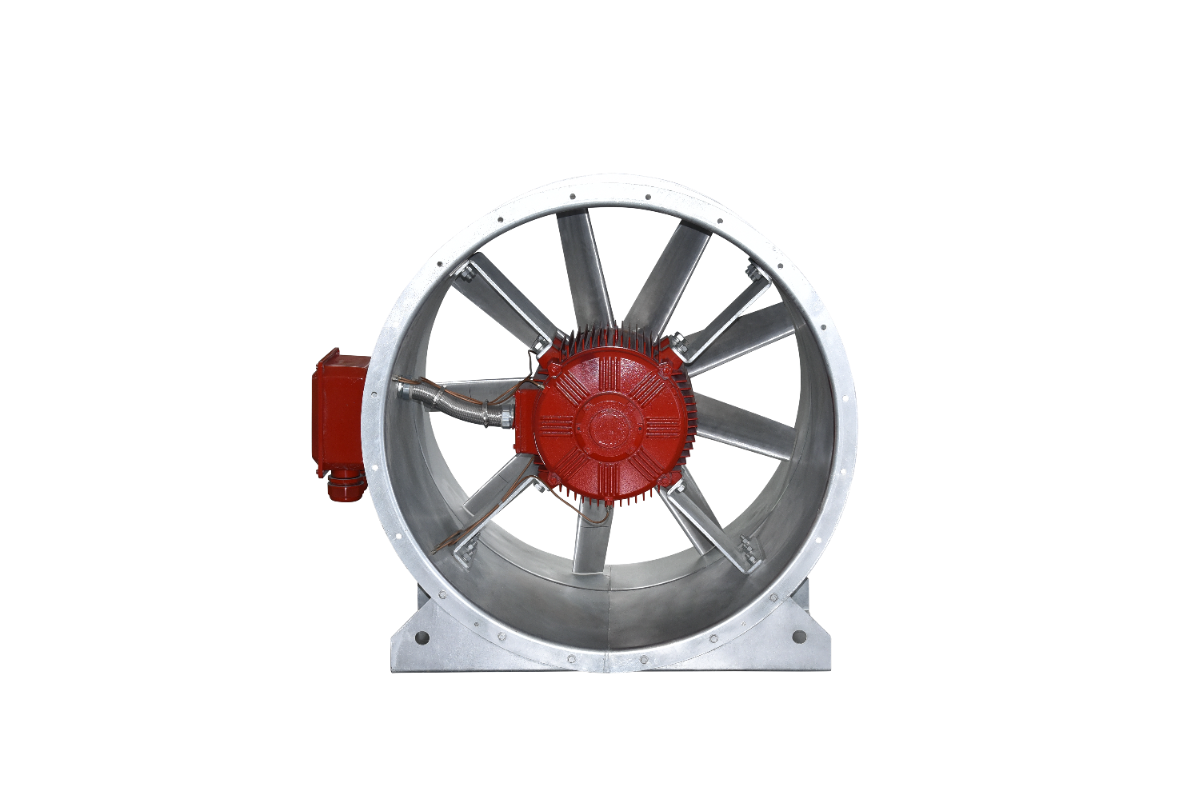
Why Blade Geometry Determines Vortex Fan Aerodynamic Efficiency
The aerodynamic efficiency of a vortex fan is fundamentally dictated by its blade geometry, as the shape and contour of the blades directly control how air is accelerated and directed. In conventional flat, uniform-chord blades, flow separation and tip vortex formation are primary sources of energy loss. Adverse pressure gradients cause the boundary layer to detach—especially near the tip—while the pressure difference between the blade’s pressure and suction sides rolls up into a strong tip vortex. This dissipates kinetic energy and disrupts the stable, coherent airflow essential to vortex fan performance.
How Curved Leading Edges and Radial Taper Redistribute Pressure Gradients
Advanced blade geometries mitigate these losses through curved leading edges and radial taper. A curved leading edge eases the initial impact of incoming air, smoothing the pressure rise and delaying boundary-layer separation across a broader operating range. Radial taper—where chord length decreases from root to tip—redistributes aerodynamic loading more evenly along the span. This reduces the pressure differential near the tip, weakening the tip vortex and lowering induced drag. Together, these features allow the fan to convert rotational energy into directed airflow with higher efficiency and less turbulence.
Advanced Blade Profiles: Swept, Asymmetric, and Tapered Designs for Vortex Fan Performance
Stall Limitations of Flat, Uniform-Chord Blades at Low Tip-Speed Ratios
Flat, uniform-chord blades suffer premature stall at low tip-speed ratios due to suction-surface flow separation. This disrupts vortex core formation, causing uneven pressure distribution and reducing mass flow efficiency by up to 19% compared to advanced profiles. The abrupt detachment also generates turbulent eddies that undermine the fan’s core acceleration mechanism.
Camber Shift and Tip-Thinning Strategies to Suppress Secondary Flow Losses
Progressive camber redistribution—shifting peak thickness and curvature toward the hub—and strategic tip-thinning counter secondary flow losses. Thinning the blade toward the tip (where rotational velocity peaks) balances aerodynamic loading and suppresses tip leakage vortices, which can waste 15–31% of kinetic energy in conventional designs. Asymmetric camber further stabilizes the vortex core by redirecting pressure gradients inward, reducing noise by 4–7 dBA. Controlled studies show tapered, asymmetric configurations achieve 12–17% higher static pressure recovery than baseline geometries.
Precision Pitch Optimization Across the Span for Stable Vortex Core Development
Consistent airflow and energy efficiency in vortex fans depend on precise pitch distribution along the blade span. Incorrect angles—particularly near the hub or tip—disrupt vortex core formation, triggering turbulence and uneven pressure distribution that wastes kinetic energy.
Nonlinear Effects of Over-Pitching on Swirl Decay and Static Pressure Recovery
Excessive tip pitch angles—beyond 35°—introduce nonlinear penalties: swirl decay accelerates by 42% compared to optimized profiles (Journal of Turbomachinery, 2023), causing premature dissipation of rotational energy before it converts to useful static pressure. Consequences include increased suction-side separation, up to 28% higher turbulent kinetic energy dissipation, and a 0.15–0.3-unit drop in static pressure recovery coefficient. Under-pitching below 20°, meanwhile, fails to impart sufficient angular momentum, yielding weak vortex formation and inadequate pressure development.
Adaptive Pitch Zoning (Root–Mid–Tip) Delivers 17% Higher Mass Flow in Vortex Fans
Progressive pitch zoning—22°–25° at the root, 28°–32° at the tip—aligns blade loading with local flow velocities, maintaining optimal angle-of-attack across operating conditions. This minimizes local stall cells and strengthens vortex coherence. Testing confirms adaptive zoning boosts mass flow by 17% versus uniform-pitch designs at identical RPMs, driven by sustained vortex core axial velocity (+15%), a 31% reduction in tip leakage vortices, and improved diffusion efficiency in the volute. The result is target airflow at lower speeds—cutting energy use by 12–18% in commercial ventilation systems.
Tip Configuration Innovations That Minimize Leakage and Maximize Vortex Fan Airflow
Forward-Swept Tips with Rounded Fillets Reduce Tip Leakage by 31%
Forward-swept tips paired with rounded fillets at the shroud interface suppress tip leakage vortices—the dominant source of aerodynamic loss in vortex fans. The concave sweep delays flow separation at the leading edge, while the fillet smooths secondary flow disturbances at the blade-shroud junction. This configuration reduces tip leakage flow by 31% compared to straight tips, delivering higher mass flow, improved static pressure recovery, and lower noise—without increasing structural complexity.
FAQ: Understanding Vortex Fan Aerodynamic Efficiency
Why is blade geometry important for vortex fan efficiency?
Blade geometry determines how air is accelerated and directed. Properly designed blades reduce flow separation, minimize tip vortex formation, and optimize energy conversion, leading to higher aerodynamic efficiency.
What role do curved leading edges play in airflow?
Curved leading edges smooth the pressure rise and delay boundary-layer separation, increasing the operating range and reducing energy losses for more efficient fan performance.
How do pitch adjustments influence vortex fan performance?
Precise pitch distribution along the blade span helps maintain consistent airflow, minimizes turbulent losses, and enhances the vortex core's stability, thereby improving energy efficiency.
What are the benefits of forward-swept tips?
Forward-swept tips with rounded fillets reduce tip leakage vortices, increase mass flow, improve static pressure recovery, and lower noise without adding structural complexity.
Table of Contents
- Why Blade Geometry Determines Vortex Fan Aerodynamic Efficiency
- Advanced Blade Profiles: Swept, Asymmetric, and Tapered Designs for Vortex Fan Performance
- Precision Pitch Optimization Across the Span for Stable Vortex Core Development
- Tip Configuration Innovations That Minimize Leakage and Maximize Vortex Fan Airflow
- FAQ: Understanding Vortex Fan Aerodynamic Efficiency