 EN
EN

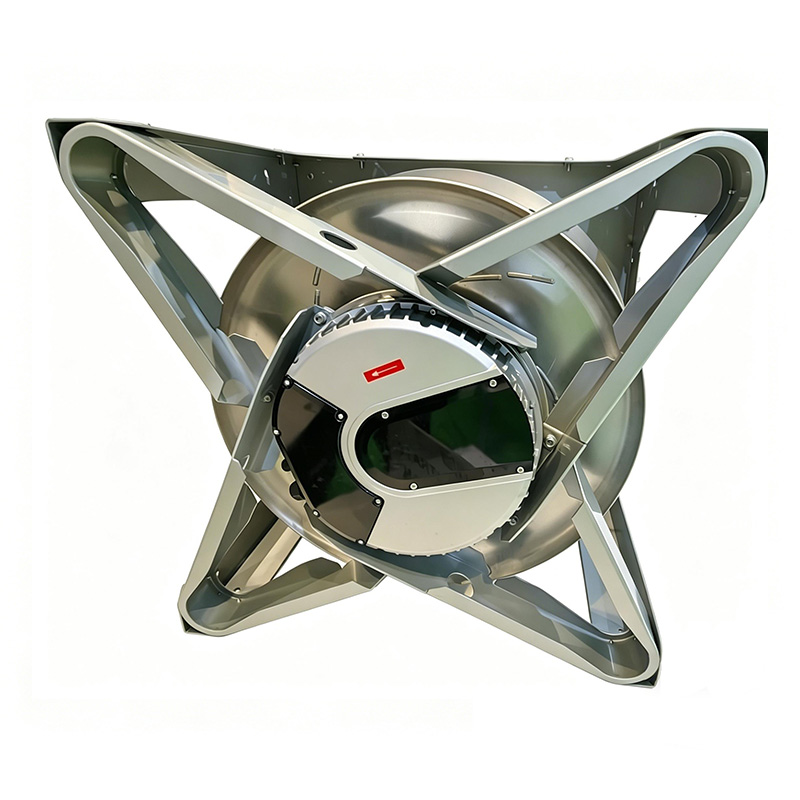
Why EC Fans Deliver Superior Reliability in Continuous Industrial Duty
An EC (Electronically Commutated) fan achieves exceptional durability through its brushless motor design and precision control electronics—eliminating the primary failure modes of traditional AC fans. In 24/7 industrial settings—from factory HVAC to data center cooling—EC fans deliver consistent airflow with minimal maintenance and a typical lifespan exceeding 50,000 hours of continuous operation.
Brushless Motor Design and High-Grade Bearings Enabling >50,000-Hour Lifespan
The core of an EC fan’s longevity is its brushless DC motor. Without brushes or a mechanical commutator, there is no sparking, carbon dust accumulation, or friction-based erosion—factors that commonly degrade brushed motors. The rotor uses permanent magnets, and the stator field is switched electronically, reducing vibration and heat generation by up to 10–15°C compared to equivalent AC induction motors.
High-grade sealed ball bearings—rated for L10 lives of 50,000 to 70,000 hours at 40°C—are standard in industrial EC fans. Unlike sleeve bearings found in many AC units, these support both radial and axial loads reliably under continuous duty. Crucially, the lower operating temperature preserves grease viscosity and slows oxidation, directly extending bearing service life.
Together, the brushless motor and premium bearings enable years of maintenance-free operation. Real-world deployments in telecom shelters and process cooling confirm that well-engineered EC fans routinely exceed 50,000 hours—reducing unplanned downtime and lowering total cost of ownership.
Electronic Commutation Stability vs. Mechanical Wear in AC Motors
AC fan motors rely on fixed-speed induction or shaded-pole designs tied to line frequency. Under changing static pressure, their speed drops sharply, increasing slip and generating excess heat—a thermal cycle that stresses windings, capacitors, and bearings over time. EC fans avoid this entirely: integrated controllers continuously adjust commutation to maintain target speed regardless of load, delivering smooth, constant torque without thermal spikes.
Electronic commutation also eliminates mechanical start switches and external VFDs. Soft-start functionality ramps current gradually, avoiding inrush stress on windings. Precise rotor-position sensing prevents torque ripple and rotor bar breakage common in single-phase AC motors—keeping the motor at its optimum efficiency point and minimizing waste heat.
This stability protects the bearing system as well. AC motors running at high slip generate vibration that can brinell ball bearings and accelerate lubricant breakdown. EC fans maintain low vibration across their full speed range, reinforcing the >50,000-hour bearing lifespan. With no brushes and inherently stable operation, EC fans are the definitive choice where non-stop performance and minimal intervention are essential.
Thermal Management: The Critical Factor for Long-life EC Fan Performance
Active Cooling Integration and Heat-Spreading PCB Layouts in Modern EC Fans
While EC fans are highly efficient, their onboard electronics remain vulnerable to overheating—the leading cause of premature failure in many industrial units. Electrolytic capacitors, for example, lose half their rated life for every 10°C rise in operating temperature. To counteract this, top-tier manufacturers integrate active thermal management directly into fan architecture.
Key to this strategy is a heat-spreading PCB layout featuring thick copper layers and thermal vias that efficiently wick heat away from driver ICs and MOSFETs. This is often paired with a dedicated internal airflow path: a small portion of the fan’s main air stream is redirected over the electronics, creating an effective, self-sustaining cooling circuit. This integrated approach keeps critical component temperatures within safe limits—even when moving hot air—directly supporting the >50,000-hour reliability benchmark of premium industrial EC fans.
How Uncontrolled Ambient Heat Triggers Premature Failure—Even in High-Efficiency EC Fans
High efficiency does not equal thermal immunity. An EC fan installed in an uncontrolled environment—such as a factory ceiling layer where ambient temperatures exceed 60°C—faces compounding risks. Elevated ambient temperatures reduce the cooling capacity of the air itself, diminishing the effectiveness of the fan’s active thermal management. More critically, they accelerate degradation of bearing grease: oxidation and base-oil evaporation increase friction, raising motor load and heat in a destructive feedback loop that often ends in bearing seizure.
This failure mode is mechanical—not electronic—and stems directly from thermal stress. A comparative study of identical fan models shows that units operating at 45°C ambient exhibit less than half the expected lifespan of those running at 25°C. Managing the installation environment is therefore just as vital as internal design in achieving long-term reliability.
Energy Efficiency and Load Adaptability: Reducing Thermal Stress with Variable-Speed EC Fans
Part-Load Efficiency Gains and Elimination of Thermal Cycling in 24/7 HVAC and Process Cooling
The variable-speed capability of EC fans fundamentally reshapes thermal dynamics in continuous-duty applications. Unlike fixed-speed AC motors forced into binary on/off cycling, EC fans modulate speed precisely to match real-time demand. Because fan power follows the cube law of speed—70% speed consumes only ~34% of full-speed power—this adaptability delivers substantial energy savings while simultaneously reducing thermal stress.
In 24/7 process cooling and HVAC systems, eliminating repeated start-stop cycles removes inrush currents and mechanical shock. The result is stable, lower operating temperatures across motor windings and bearings—avoiding peak thermal spikes that accelerate insulation degradation. Rather than being a source of failure, the EC fan becomes a foundation of long-term system reliability.
Total Cost of Ownership: Quantifying Long-term Value of Industrial EC Fans
10-Year TCO Comparison: EC Fans vs. AC Fans in Factory HVAC and Data Center Applications
Evaluating industrial cooling solutions on a 10-year total cost of ownership (TCO) basis reveals the compelling economic case for EC fans. Although initial unit cost is typically 25–50% higher than comparable AC fans, energy savings alone recover the premium in 2–3 years in continuous-duty environments like data centers and factory HVAC.
The table below illustrates a representative 1 kW fan operating 24/7:
| Cost Component | EC Fan | AC Fan |
|---|---|---|
| Initial Purchase & Installation | $1,500 | $1,000 |
| Annual Energy Cost (8,760 hrs) | $350 | $700 |
| 10‑Year Energy Cost | $3,500 | $7,000 |
| Maintenance & Downtime (10 yrs) | $500 | $1,500 |
| Total 10‑Year TCO | $5,500 | $9,500 |
Beyond energy, EC fans’ brushless construction and built-in condition monitoring significantly reduce unplanned maintenance and downtime. For large-scale installations—such as data centers deploying hundreds of fans—the cumulative operational and financial advantages become strategic, confirming EC technology as the clear TCO leader.
FAQ
What is an EC fan and how does it differ from an AC fan?
EC fans use brushless DC motors with integrated electronic controllers, unlike AC fans which rely on mechanical components like induction or shaded-pole motors. This makes EC fans more durable and energy-efficient.
How long do EC fans typically last?
EC fans often exceed 50,000 hours of continuous operation thanks to their brushless design and high-grade bearings.
What factors influence the lifespan of an EC fan?
The lifespan is influenced by thermal management, bearing construction, and operating conditions. Elevated ambient temperatures or mechanical stress can shorten their lifespan.
What are the energy benefits of EC fans compared to AC fans?
EC fans are highly energy-efficient, with part-load capability significantly reducing power consumption. The cube law of energy means 70% speed consumes about 34% of full-speed power.
Are EC fans more expensive to install than AC fans?
Yes, initial cost is higher, typically 25–50% more. However, their energy savings and reduced maintenance recover the investment within 2–3 years.
What applications are ideal for EC fans?
EC fans are ideal for 24/7 industrial environments like factory HVAC systems and data centers, where reliable, long-term performance is critical.
Table of Contents
- Why EC Fans Deliver Superior Reliability in Continuous Industrial Duty
- Thermal Management: The Critical Factor for Long-life EC Fan Performance
- Energy Efficiency and Load Adaptability: Reducing Thermal Stress with Variable-Speed EC Fans
- Total Cost of Ownership: Quantifying Long-term Value of Industrial EC Fans
- FAQ