 EN
EN

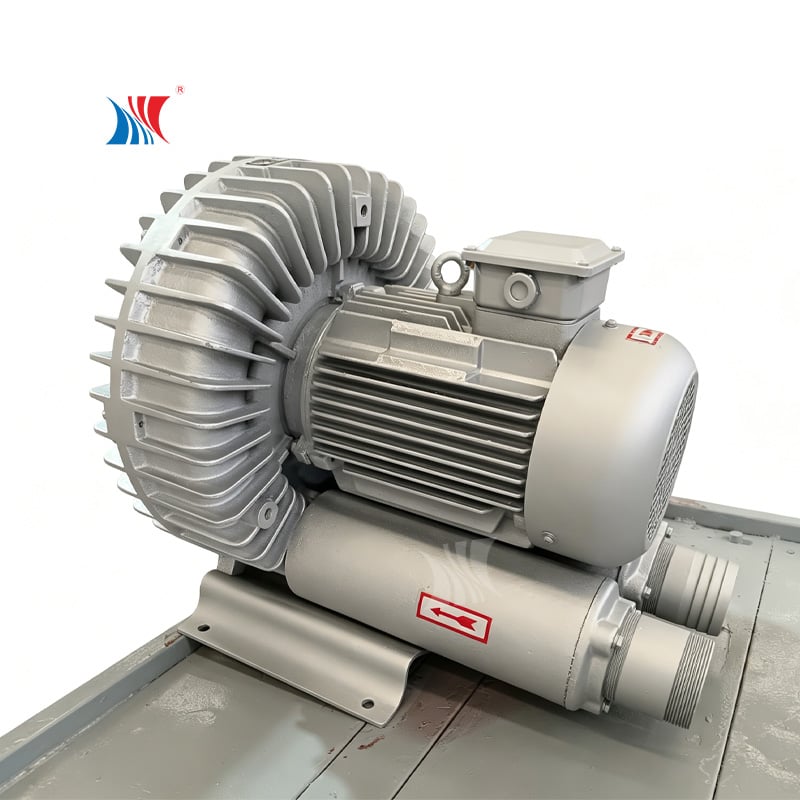
Why Vortex Blowers Are Ideal for Industrial Exhaust Applications
Vortex blowers—also known as regenerative or side channel blowers—deliver a unique blend of performance traits that directly meet the demands of industrial exhaust systems. Unlike traditional fans or positive displacement blowers, they generate smooth, non-pulsating, high-volume airflow by recirculating air within a compact housing, incrementally building pressure across multiple impeller passes. This results in a steady exhaust stream—critical for processes intolerant of pressure fluctuations, such as fume extraction in chemical processing or continuous chip removal in machining.
Because the impeller rotates without metal-to-metal contact inside the casing, vortex blowers operate entirely oil-free. That eliminates contamination risk in sensitive exhaust streams and dramatically reduces maintenance. Their inherently quiet, vibration-free operation also minimizes the need for bulky sound enclosures—especially valuable in noise-sensitive facilities.
Built for durability, many models feature robust, wear-resistant materials capable of handling moderate particulate loads like dust, smoke, or light debris. Thanks to the regenerative principle, they maintain stable performance across a wide pressure range, adapting reliably to variable exhaust demands without surging or stalling. When correctly sized, vortex blowers provide consistent, energy-efficient exhaust for 24/7 operations—making them a cost-effective alternative to more complex vacuum pumps or centrifugal fans in applications including welding fume removal, drying oven venting, and pneumatic conveying of waste material.
Critical Vortex Blower Selection Criteria: Airflow, Pressure, and Environment
The foundation of any successful industrial exhaust system lies in precise vortex blower sizing. A mismatch between the unit’s capabilities and system demand is a leading cause of energy waste and premature failure. Selection must go beyond nominal ratings to assess how the blower performs under real-world operating conditions.
Matching CFM and static pressure to system requirements using performance curves
The first step is aligning the system’s calculated airflow (CFM) and total static pressure (SP) requirements with the blower’s documented performance curve. CFM and SP are interdependent: as system resistance rises, airflow drops along a predictable path. The operating point is where the system resistance curve intersects the blower’s performance curve. Systems with long duct runs, multiple bends, or inline filters exhibit steep resistance curves—requiring a blower that delivers sufficient pressure at the target CFM. Selecting based solely on peak CFM—without verifying performance at the required pressure—leads to under-delivery and process bottlenecks.
Always review the full manufacturer-provided fan curve—not just a single data point. It should define the blower’s stable operating region, surge limits, and power draw across its entire range. Choosing a unit that operates near its peak efficiency zone can cut long-term energy costs significantly; even a 10% efficiency gain compounds meaningfully over continuous-duty cycles.
Adjusting for real-world conditions: temperature, altitude, humidity, and particulate load
A blower rated for standard air at sea level will perform differently in hot, high-altitude, or humid environments. Vortex blowers move a constant volume of air—but the mass flow changes with air density. High temperatures and elevated altitudes reduce density, lowering mass flow and exhaust effectiveness. As noted by the U.S. Department of Energy (2007), fan performance must be corrected for non-standard air density to ensure design mass flow rates are achieved.
Conversely, high humidity or particulate-laden airstreams increase effective density—and introduce mechanical risks. Suspended particles accelerate impeller erosion and can accumulate, causing imbalance and vibration. In such cases, material specifications—like stainless steel construction or corrosion-resistant coatings—are as vital as pressure and flow ratings. Motors must also include an appropriate service factor to handle increased thermal and mechanical loads without overheating.
A rigorous selection process evaluates worst-case conditions: adjusting the performance curve for the lowest expected air density at the site, while specifying mechanical components hardened against the most abrasive or corrosive elements in the exhaust stream.
Ensuring Safety and Compliance in Hazardous Industrial Exhaust Environments
Industrial exhaust systems in chemical plants, oil refineries, and grain processing facilities often handle atmospheres containing flammable gases, vapors, or combustible dust. A single spark from a non-certified blower can trigger a catastrophic explosion. According to the U.S. Chemical Safety Board (2018), combustible dust incidents alone caused over 22 fatalities and 128 injuries between 2006 and 2017. Selecting a vortex blower with recognized safety certification is not merely regulatory compliance—it is essential risk mitigation. Even surface temperatures exceeding the auto-ignition point of surrounding gases pose serious hazards. Compliance with ATEX Directive 2014/34/EU in Europe—or equivalent IECEx or NEC standards—ensures the blower’s design eliminates all potential ignition sources, even during fault conditions.
ATEX and explosion-proof certification for volatile or combustible atmospheres
For use in hazardous areas, vortex blowers must carry ATEX certification for the EU or IECEx certification internationally. These frameworks classify equipment by zone (e.g., Zone 0 = continuous explosive atmosphere; Zone 1 = likely; Zone 2 = rare), gas group (IIA, IIB, IIC), and temperature class (T1–T6). A blower deployed in a hydrogen-rich environment (IIC, T1), for example, requires the highest protection level.
Dust-specific hazards demand additional safeguards: equipment certified for explosive dust (ATEX Category 2D or 3D) with ingress protection of at least IP6X. Certification involves rigorous testing by a notified body to verify that motor, casing, and impeller can safely contain internal explosions without transmitting flame externally.
Without this certification, the ignition risk remains unacceptably high—exposing facilities to severe financial penalties, operational shutdowns, and life-threatening consequences.
Frequently Asked Questions (FAQ)
What are vortex blowers?
Vortex blowers, also known as regenerative or side channel blowers, generate high-volume, smooth, non-pulsating airflow by recirculating air within their compact housing and incrementally building pressure across multiple impeller passes.
What makes vortex blowers suitable for industrial exhaust systems?
Vortex blowers offer oil-free, contamination-resistant operation, quiet performance, energy efficiency, and durability, making them ideal for tasks like fume extraction, pneumatic conveying, and drying oven venting.
How are vortex blowers selected for industrial applications?
Selecting vortex blowers involves analyzing system requirements for airflow (CFM) and static pressure (SP), while adjusting performance for environmental factors like temperature, altitude, and particulate loads.
Why is ATEX certification important for vortex blowers?
ATEX certification ensures vortex blowers meet safety standards for use in environments with combustible dust or flammable gases, mitigating ignition risks and ensuring compliance with international safety regulations.